Chatiarchar: Life Beyond the Beauty of the Haor
<p>Mymensingh–Kishoreganj Tour: Day 1 From a Friend’s Home to the Haor Life of Chatiarchar Our first day began at our friend’s home in Gafargaon. After having breakfast sometime between 10:00 and 11:00 in the morning, we packed our things and set out for Kishoreganj. The journey was not direct. We had to change vehicles several […]</p>
Mymensingh–Kishoreganj Tour: Day 1
From a Friend’s Home to the Haor Life of Chatiarchar
Our first day began at our friend’s home in Gafargaon. After having breakfast sometime between 10:00 and 11:00 in the morning, we packed our things and set out for Kishoreganj.
The journey was not direct. We had to change vehicles several times because no single auto-rickshaw or CNG would take us all the way to our destination. We travelled in short stages—getting down at one point, looking for another vehicle and then continuing again.
According to our recorded route, we passed through places including Hossainpur, Kishoreganj New Jail Mor, Akrampur CNG Station, Nauli Bridge and several small local markets before reaching Chatiarchar in the late afternoon.
Reaching Chatiarchar by Boat
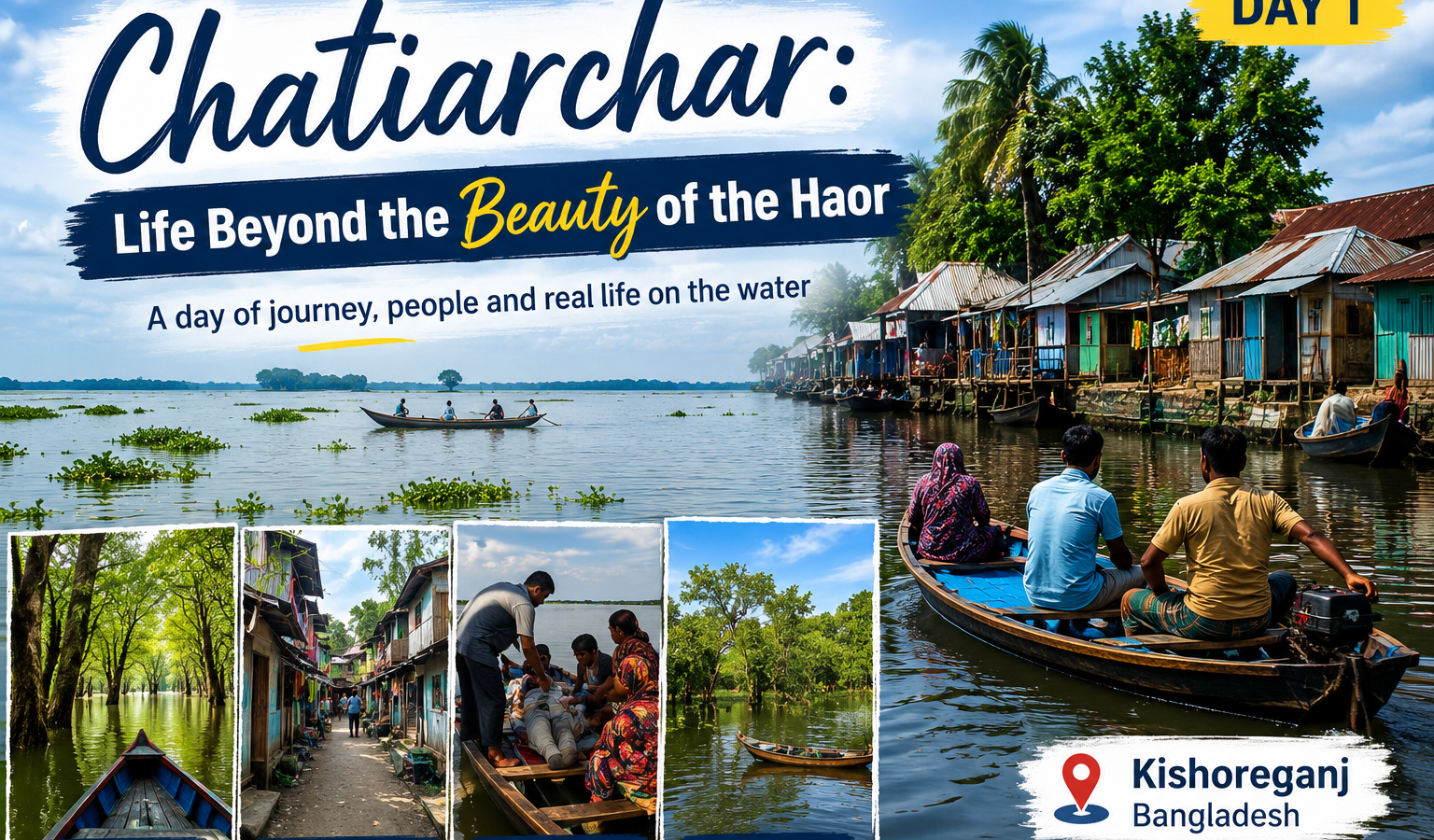
The final part of the journey had to be completed by water. We boarded a local motorised wooden boat and crossed the open haor to reach Chatiarchar.
The first sight of the haor was striking. Water stretched towards the horizon, broken only by patches of water hyacinth, distant boats and small settlements. The vast open landscape felt completely different from the crowded roads and markets we had passed earlier.
After getting off the boat, we began walking through the settlement. At first, the area appeared to have few conventional tourist attractions. But the real value of Chatiarchar was not a constructed attraction—it was the community itself.
Life Inside the Settlement
The houses were built very close to one another. Narrow lanes connected one home to the next, and almost no open land remained unused. Because of erosion, flooding and the limited amount of habitable ground, families had gradually shared smaller spaces and built wherever land was available.
We spoke with local residents and tried to understand their daily lives. Fishing is one of their primary livelihoods. Many families also raise cattle, goats, ducks and chickens or operate small local businesses.
Their lives seemed simple but not necessarily unhappy. They worked throughout the day and, after Asr or towards evening, gathered to talk and spend time together. Community cooperation played an important role in their survival. When someone lost land or faced damage caused by water, neighbours often supported them by sharing space and resources.
The local market was commonly referred to as Chatiarchar Bazar, while some residents also called it Mela Bazar.
The Difficult Reality of Medical Emergencies
One of the most important things we learned was how difficult access to emergency healthcare could be for people living in the haor.
For minor illnesses, local treatment might be available. But for a pregnant woman, a seriously ill patient or anyone requiring urgent hospital care, the journey could become extremely difficult. In many cases, a boat is the only practical means of leaving the settlement.
We witnessed this reality during our return journey.
A severely ill woman was being transported in the same small motorised boat. She was not strong enough to sit normally, so she had been placed on a chair. Two women and a man stayed close to her, holding both her and the chair steady.
At that time, the water had become rough. Strong waves repeatedly struck the boat, making it jump and hit the surface hard. For us, the ride felt tense and adventurous. But for the patient and her family, the same journey was an exhausting struggle to reach medical care.
That moment changed the meaning of the boat ride. What looked like an exciting experience to a visitor was part of everyday survival for the people who lived there.
The Mini Ratargul of Chatiarchar
During the boat journey, we also passed a waterlogged forested area marked on Google Maps as Chatiarchar Water Park—Mini Ratargul.
Rows of trees stood partly submerged in water, creating the appearance of a small swamp forest. Boats rested near the trees, people swam in the water, and sunlight filtered through the foliage. Compared with the open haor, this shaded area had a quieter and more enclosed atmosphere.
Returning Through the Evening Route
After leaving Chatiarchar, we continued through the evening using a combination of boats, autos and local transport. Our recorded route passed through Hilochia Bazar, Sararchar and Katiadi Bus Station.
The day’s journey ended at Ujan Bhati Hotel & Chinese Restaurant in the Gauranga Bazar area at approximately 8:24 PM.
By the end of Day 1, we had travelled through busy roads, small markets, bridges and wide stretches of water. More importantly, we had seen a way of life shaped by the haor—beautiful from a distance, but demanding for the people who depend on it every day.
Day 1 was not simply about visiting a scenic location. It was an opportunity to observe community life, resilience and the difficult reality hidden behind the beauty of the water.
Day 1 route:
Gafargaon → Hossainpur → Kishoreganj New Jail Mor → Akrampur → Nauli Bridge → Chatiarchar Bazar and haor area → Hilochia Bazar → Sararchar → Katiadi Bus Station → Ujan Bhati Hotel, Gauranga Bazar.